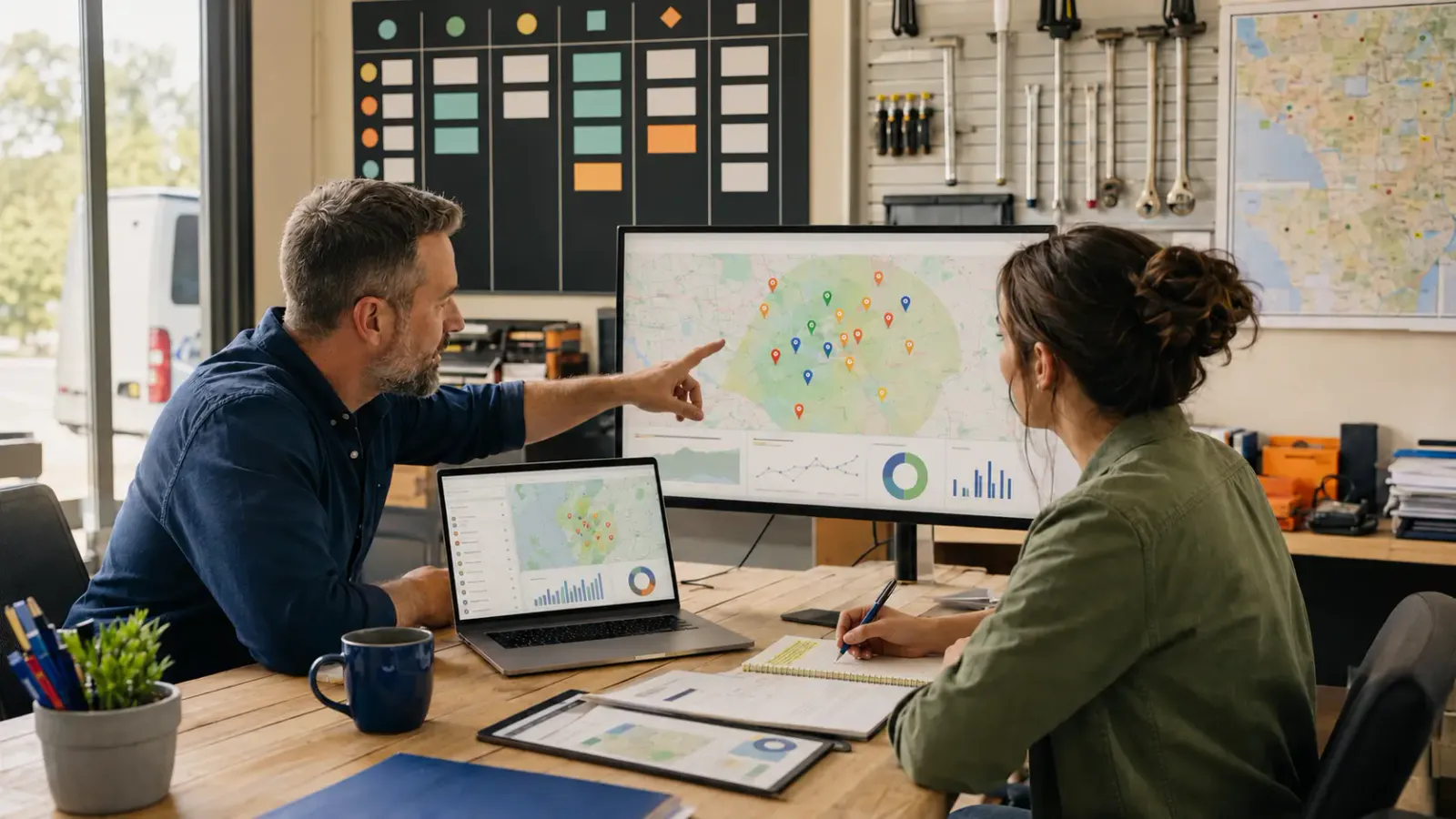
A customer can discover a business, compare options, read reviews and place a call without visiting the company's website.
That journey is often called zero-click search. The name makes it sound as though nothing happened. In reality, a buying decision may be well underway.
For home service companies, franchise systems and other local brands, the strategic problem is not simply losing website traffic. It is losing visibility into how customers discover, evaluate and choose the business across Google Search, Maps, AI answers, directories and review platforms.
The old scorecard,rankings, sessions and form fills,does not tell the whole story anymore.

What changed in local discovery
AI Overviews and AI Mode can combine information from multiple sources before presenting an answer. Google explains that these experiences may use a query fan-out process, running related searches across subtopics and data sources to build a response.
A homeowner searching for a contractor may now ask a layered question:
Which local companies repair this problem, serve my neighborhood, have strong recent reviews and can schedule the work this week?
That question touches service relevance, location, reputation, availability and trust. No single keyword ranking represents the whole journey.
At the same time, the local pack and Google Business Profile already provide phone calls, directions, hours, photos and reviews directly in the results. The click did not disappear because the customer lacked intent. It disappeared because the search result supplied the next step.
SEO still matters,just not as a traffic-only program
There is plenty of breathless advice claiming that AI search requires a completely new optimization discipline. Google's own guidance is more grounded: foundational SEO remains relevant, and there are no special technical requirements to appear in AI Overviews or AI Mode beyond being indexed and eligible to appear in Search.
That means the work is familiar:
- Publish accurate, useful, people-first information.
- Keep important pages crawlable and indexable.
- Use clear page titles, headings, links and descriptive language.
- Demonstrate real experience and answer the questions customers ask.
- Maintain strong local business information and reputation signals.
Google's generative AI optimization guide specifically reinforces the continued value of good SEO rather than a separate shortcut for AI visibility.
The shift is in how the work connects. Your website, Google Business Profile, reviews, directory information, videos and earned mentions all help customers,and search systems,understand the business.
Build a source of truth
Start with the information a customer needs to verify before contacting you:
- Services performed and important exclusions.
- Real service areas and physical locations.
- Hours, phone numbers and response expectations.
- Licenses, certifications, warranties or guarantees that can be substantiated.
- Current photos, project examples and team expertise.
- Frequently asked questions based on real sales and service conversations.
Keep these facts consistent across the website and major profiles. If one source says you serve the entire state, another lists three counties and a location page names only one city, the business becomes harder to understand.
For multi-location organizations, consistency should not mean duplication. Each location page needs real local proof, contact details, service coverage and customer context. Our franchise local SEO guide explains how to create that shared structure without turning every page into a city-name swap.
Make the website worth citing and visiting
AI-assisted results may answer simple questions directly. The website still earns the visit when it offers something deeper, more specific or more useful than a summary.
Strong local content includes:
- Before-and-after project stories with the situation, decision and outcome.
- Service pages that explain who the work is for and what happens next.
- Original comparisons based on field experience.
- Regional guidance tied to climate, regulations, materials or seasonality.
- Clear pricing context when exact prices are not practical.
- Videos and photos showing the people, process and work.
This is not a content-volume contest. Ten nearly identical city pages will not create the trust that one detailed local project story can.
If your current foundation needs work, use the 2026 local SEO checklist for home services to review profile accuracy, service pages, reviews, local authority and conversion paths.
Treat reviews as customer language, not just stars
Reviews help potential customers evaluate risk. They also describe the business in language that websites and marketing teams often overlook.
Look for recurring phrases about:
- The problem the customer needed solved.
- The neighborhood or service area.
- The speed and clarity of communication.
- Specific employees, services or products.
- The result and what made the experience different.
Do not script review language or pressure customers to mention keywords. Build a consistent, policy-compliant request process and let genuine customers describe the experience in their own words.
Google says local results are primarily shaped by relevance, distance and prominence. Reviews support prominence and trust, but they do not override inaccurate categories, weak relevance or the physical realities of distance.
Measure the actions around the click
If organic sessions decline while qualified calls, branded searches and booked work hold steady, the business may be visible in places the website analytics cannot fully capture.
Build a broader scorecard:
- Google Business Profile calls, messages, directions and website actions.
- Search Console impressions, branded queries and priority-page visibility.
- Calls and forms tied to landing pages and source data.
- New and returning users by channel.
- Branded search growth.
- Review volume, recency and response rate.
- Qualified opportunities, booked appointments and closed revenue.
- Assisted conversions and customer-reported discovery source.
No single metric proves AI visibility. Use several signals, watch the trend and connect marketing activity to the customer record wherever possible.
What local brands should do next
Over the next 30 days:
- Verify business facts across the website, Google Business Profile and major directories.
- Identify the five questions sales or service teams answer most often.
- Strengthen one priority service or location page with original proof.
- Create a repeatable review request and response process.
- Confirm that calls, forms and booked appointments are measured.
- Add branded search and Business Profile actions to the monthly report.
- Review the full path from discovery to qualified revenue.
The goal is not to force every searcher onto the website. It is to make the business understandable, credible and easy to choose wherever the decision happens.
Ready to see where local demand is getting lost?
Strats & Roadmaps helps home service and multi-location businesses connect local SEO, reputation, content and measurement into one practical system. Start a conversation and we will map the gaps between being found and being chosen.